

Someone is standing in the seasonal aisle holding a bag of paper marigolds, wondering if they are allowed.
They have seen the arguments. They have a grandmother who died this past February. Hesitation sinks in and they put the marigolds back.
That hesitation is worth taking seriously and the question underneath it is worth answering. But the question is not quite the right one and the reason becomes obvious the moment you look at what this holiday actually is in the places that keep it.
It is not one holiday. It is three, at least and they do not look exactly alike. More importantly, there is an overarching CONCEPT that prevails over all iterations of this holiday. So the question goes beyond celebrating a holiday and more so how can one tap into this ideological CONCEPT of “Day of the Dead?”.

Sumpango
On the first of November, in the highland town of Sumpango in Sacatepéquez, Guatemala, they fly kites the size of blue whales.
Barriletes gigantes, built on bamboo frames and papered in cut tissue, some of them twenty meters across, raised in a field above the cemetery. These kites take months to make. The designs carry messages and the kites are understood as messengers: the words go up into the skyworld, the dead receive them. The neighboring town of Santiago Sacatepéquez does the same.
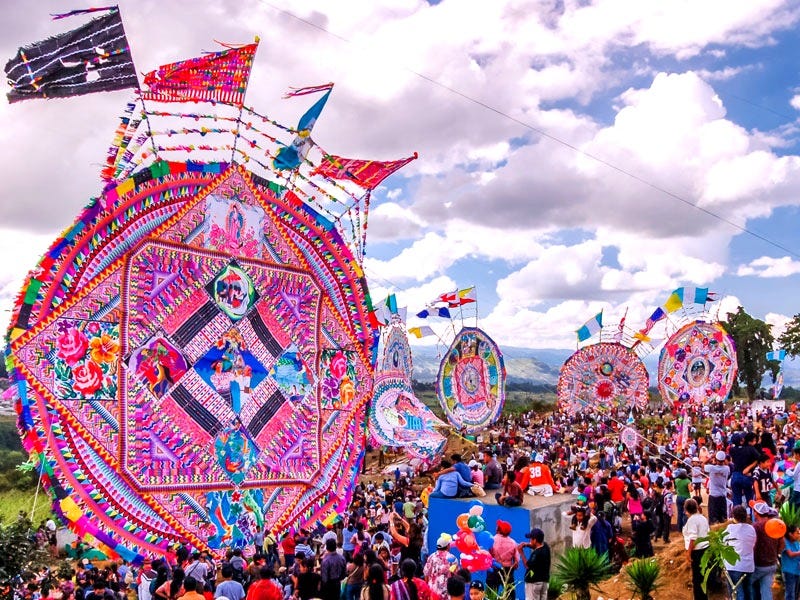
There is no ofrenda in this picture. There are no marigolds. There is wind and paper and a rope held by a dozen men.
What families eat that day is fiambre, a cold dish built from dozens of ingredients, cured meats and pickled vegetables and cheeses layered in a basin, which has to be started days in advance and which almost every family makes differently. The recipes are the ancestral inheritance. Then they go to the cemetery, repaint the graves and sit with their dead.
Sumpango and Santiago Sacatepéquez are Kaqchikel Maya towns and ofrendas in the commonly understood sense are not found here.
Corozal
In northern and western Belize, the Maya and Mestizo communities keep Los Finados and they keep it for nine days, from the first of November through the ninth. 9 Days seems to be an illusion to the 9 levels of the Maya Underworld and perhaps as well as the 9 Lords of Night found in Mesoamerican Astrology.
The first day belongs to the children, Día de los Angelitos and the altars hold sweet bread and candy. The second belongs to the adults. The food is specific: conservas, fruits stewed down with sugar, pumpkin and papaya and craboo; bollos, masa with ix’pelón beans; and ix’pasha, a porridge of purple corn that only the cook is permitted to taste 👨🍳.
Add candles. Beeswax, velas de cera, set on the altar and allowed to burn all the way down, never blown out. Candle flames are divination. A flame leaning east means the spirits are arriving. Leaning west means they are going. Interestingly, the dead in Belize are not seen as skeletons like in Mexico but rather wisps of the wind known as iik’ in Maya.
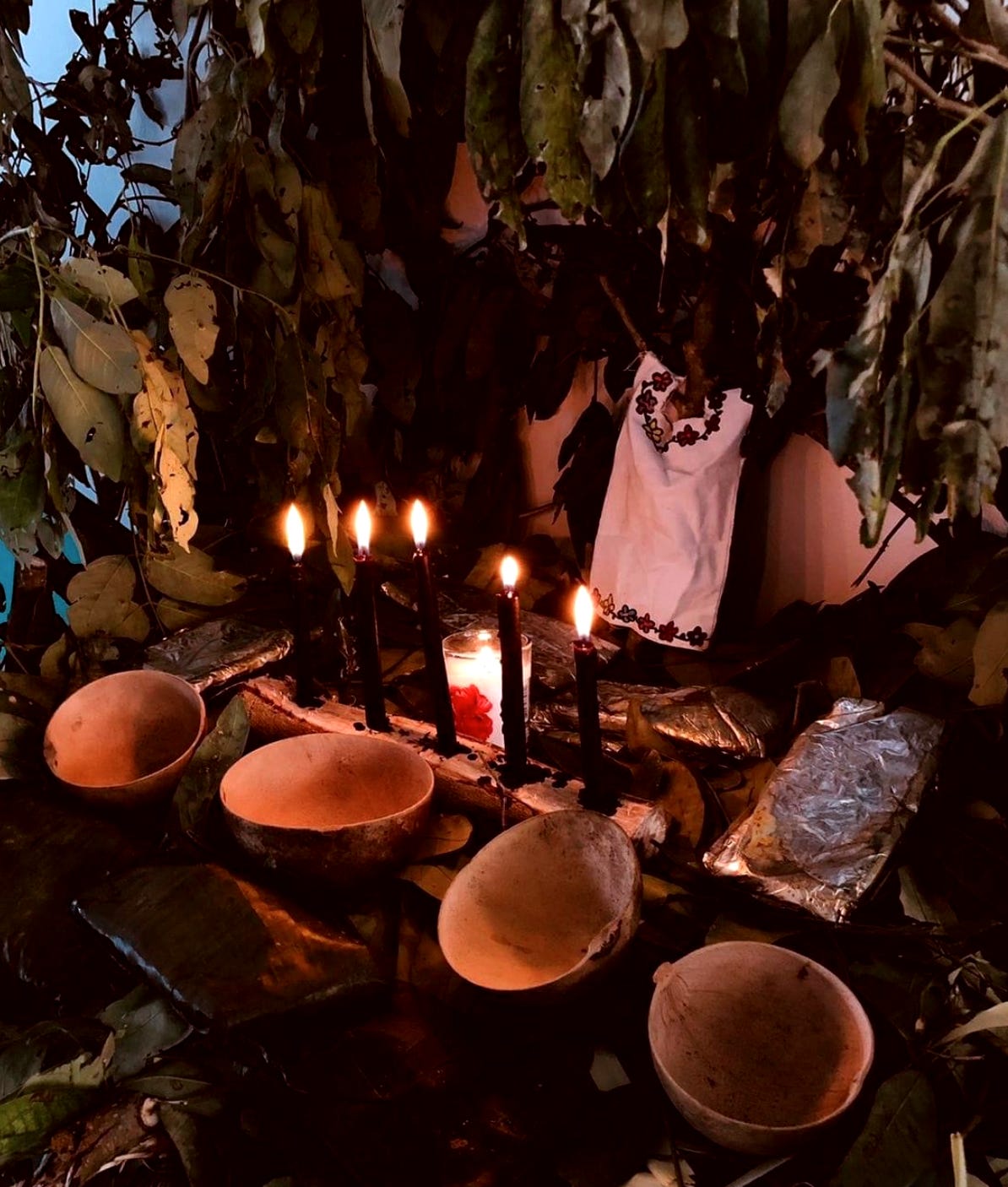
Nine days of prayer and then on the ninth the candles go out along the roadsides and the procession walks to the cemetery.
The tradition is named for its source: Hanal Pixán, Yucatec Maya, the food of the souls. The same practice runs across the border in Yucatán, where the great dish is mucbipollo, a tamal the size of a wheel, baked in a pit in the ground.
Oaxaca
And then there is the holiday most readers already know. The ofrenda built in tiers. Cempasúchil, the marigold, whose scent is the road the dead walk in on. Pan de muerto. Water for the thirst of the journey. Salt. Copal. The photograph. The sugar skulls with names written across the forehead.

This is the version that traveled widely. But should be duly noted, one regional practice among many, which became the face of the holiday for reasons that had a great deal to do with the twentieth century and not very much to do with the dead.
So Who Is It For?
Let’s analyze these 3 festivities again shall we:
Kaqchikel kites.
Belizean beeswax candle flame divination.
Oaxacan table spreads laid in tiers.
These are not variations of a single script. There is no single script. Each of these communities faced the same fact, which is that at this turn of the year the dead come back and have to be received and each one answers it with what was in their hands: the wind they had, the corn they grew, the flowers that bloomed in their season.
Popular history says all of this descends in a straight line from a Mexica (Aztec) festival. Stanley Brandes and Elizabeth Carmichael and Chloë Sayer, have argued that the Iberian Catholic contribution is far larger than that story admits and that post-revolutionary Mexican nationalism was major in constructing the continuity; Regina Marchi has traced how the holiday’s observance spread and changed as time and circumstance past.
What survives all of that argument is the structure:
The dead return>>>the dead are fed>>>the living eat afterward.
So here is the answer…
Your dead are yours. Setting a table for your own dead takes nothing from anyone and there is no one on earth with the standing to tell you otherwise. The hesitation in the seasonal aisle is not moral caution as much as it is confusion about what the holiday asks.
The forms are to be understood and respected. The giant kite belongs to Sumpango. The fiambre belongs to Guatemalan families who have been refining a basin of it for four generations. The name Hanal Pixán belongs to Yucatán. The calavera face belongs to people who are mourning. Knowing and honoring these particulars opens the door to tasteful experience.
The line is not between insiders and outsiders. It is between feeding your dead and wearing someone else’s inheritance. Borrowing a form without its obligation is not a manners problem; it is a structural one and I have written at length about how that loop actually works and what it costs the communities on the other end of it:

What the Table Is Actually For
An ofrenda is not decor. It is a liminal place constructed by you and the ancestral memory of this Native American continent.
This isn’t just secular remembrance. You are feeding a familiar invitee. That is why the food has to be food they ate, why the water is there, why in Belize the cook alone tastes the ix’pasha and everyone else waits. The dead are served first as honored guests and afterward the living sit down and eat the rest. The meal is the hearth of this liminal memory. The obligation runs both directions and it does not end when the candles do.
This is also why a table assembled from a craft store kit may oftentimes sit inert. Not because the buyer lacked permission. Because nobody was ritually invited. There is no name on it, no dish anyone has distinguished with the efforts of the heart, tear ducts or synapses of remembrance.
The holiday is spreading across this continent right now because it offers something the dominant culture does not: a date on the calendar when the dead are expected rather than merely missed. That hunger touches us all who reside on Turtle Island and it is not theft.
Say the Name
Your grandmother who died last winter has a name. She had a dish. There is a thing she used every day that is probably still in a drawer somewhere in your family.
The requirement is harder than asking permission. It requires more knowledge about the cultures and your standing within the time and place of the continent.
So: How do you choose to honor the continental structure of this hallowed time? And whose name would go on your table?
Part Two, for Mystery Codex paid subscribers, goes up later this week: how to build a table that actually works, using cultural correspondence, honoring the culture involved and our own spiritual strength.
Services
Mayan Life Path Astrology Birth Chart Reading: an in-depth soul blueprint analysis that reveals your cosmic destiny through ancient Maya Telluric Astrology, analyzing your daysign, trecena, Venus cycle, Lord of Night, birth year energy and peak manifestation days based on your exact birth moment.
Notes
On the giant kites of Sumpango and Santiago Sacatepéquez and on fiambre: Revue Magazine, “October–November Traditions in Guatemala.”
On Los Finados in Belize, the nine-day observance, the foods, and the reading of the candle flame: Belize Tourism Board, “Honoring the Dead: Los Finados in Belize,” travelbelize.org. Confirmed in conversation with a family friend in Belize, October 2026.
On Hanal Pixán and Belizean All Souls’ practices: Chaa Creek, “All Souls Day in Belize: A Tapestry of Traditions and Cultural Harmony,” 2023.
Stanley Brandes, Skulls to the Living, Bread to the Dead: The Day of the Dead in Mexico and Beyond (Oxford: Blackwell, 2006); Elizabeth Carmichael and Chloë Sayer, The Skeleton at the Feast: The Day of the Dead in Mexico (London: British Museum Press, 1991); Regina M. Marchi, Day of the Dead in the USA: The Migration and Transformation of a Cultural Phenomenon (New Brunswick: Rutgers University Press, 2009).