

From Sedona, Arizona to Tulum, Mexico you’ll find, “Sacred Cacao Ceremony,” “Chocolate Shamanism,” “Cacao Journey with the Goddess Ixkakaw.” Pay your three to four figure premium, drink spiced hot chocolate and unlock ancient Mayan wisdom “suppressed for centuries.”
Except none of it is ancient. All of it is out of context and to top it all off…the goddess doesn’t exist.
The entire cacao ceremony phenomenon was invented around 2011 by a Canadian named Keith Wilson. Yes, Invented. Then marketed to indigenous communities in Guatemala as their own “lost tradition” before being sold worldwide as authentic shamanic practice.
This is a straight up fabrication with an easy paper trail to find. Like any pyramid scheme it is complete with certification programs where you can become a licensed “cacao guardian.” It’s the Pizza Effect that I have written about previously: create a fake tradition, sell it to the culture you’re appropriating from, then sell it back to the world as ancient wisdom.

What Cacao Actually Meant to the Maya
Theobroma cacao, the egghead word for the cacao tree, has played a genuine role in Maya civilization for over two millennia. Archaeological evidence from Colha in Belize revealed theobromine residues in spouted vessels from Preclassic burials, confirming elite class use of cacao beverages. [^1]
Precolumbian cacao drinks were served hot and spiced with chili spices or blended with vanilla, corn or honey. Murals at Calakmul depict elites drinking cacao during diplomatic discussions. The glyph reads KAK-A-WA, pronounced essentially the same today. [^2] Servers poured liquid from standing position into floor vessels, creating frothy tops scraped off with bone or turtle shell spoons. A ceremony in the sense that Japanese tea ceremony is ceremony: formalized social ritual, diplomatic protocol, elite cultural practice. [^3]
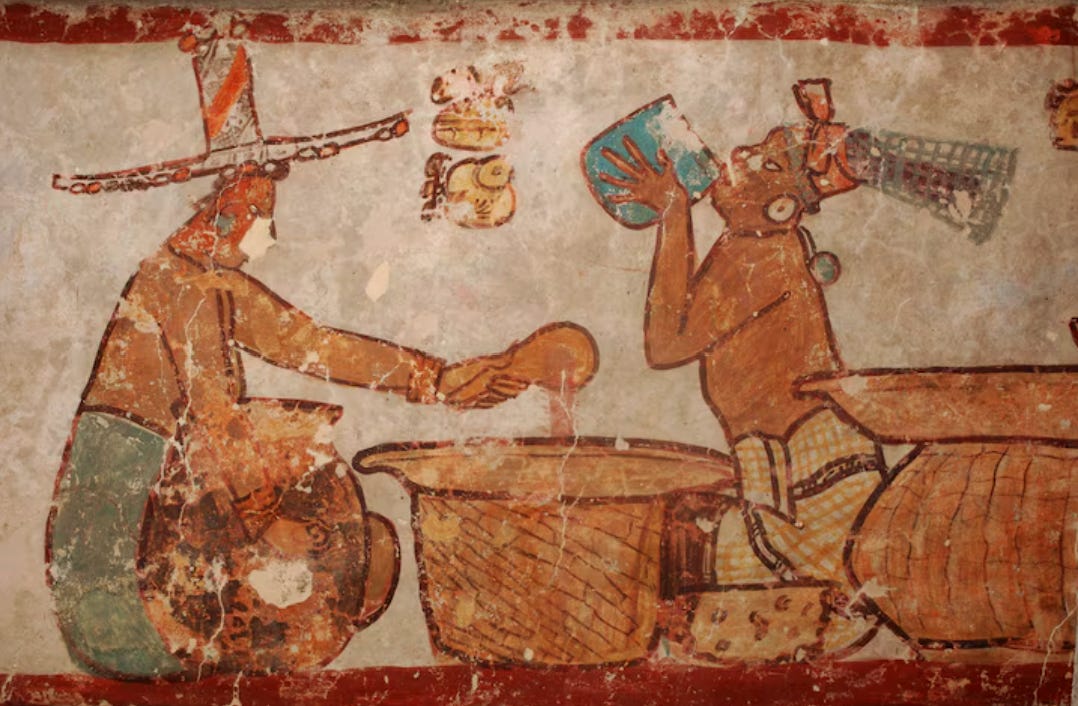
Cacao beans served as currency for centuries. The deity Ek Chuah was patron of both merchants and cacao. Ek Chuah is linked to Ha’al Chuah, an elderly figure surrounded by cacao pods, a grandfather spirit linking merchants, wealth and cacao. [^4]
Despite Theobroma meaning “food of the gods,” this brown brew was never used for shamanic rituals. Cacao was reserved for the elite, similar to matcha in Japanese tea ceremony. Present-day Guatemalan communities serve cacao (like other beverages such as Tamarindo and Maranon) as hospitality, like offering coffee. [^5] It’s hospitality, not mysticism.
What Contemporary Maya Practitioners Actually Say
In a March 16, 2024 interview on Maya Daykeeper’s YouTube channel, contemporary Aj’qi Apab’yan Tew explained exactly how authentic indigenous practice uses cacao:
“Cacao seeds are used ceremonially for payment in healing. You can count cacao seeds for different reasons in front of the bonfire or the fire that you do for healing purposes to connect to the lords of the days…but there is no actual ceremony (for cacao). It is an offering…when they say cacao is sacred, sure, because everything is sacred to the Maya.” [^6]
Elegantly put; there is not much that segregates the sacred from the non-sacred in the Maya cosmovision. Cacao is respected and valued, yes. Cacao is used ritually as an offering among other offerings. But there is no transcendental experience associated with cacao in ancient or contemporary Maya practices.
Sooooo…how did a drink with similar properties and status to a latte become the backbone of reaching enlightenment?
Enter Keith Wilson: The Inventor
According to Wilson’s own account on his website (keithscacao.com), he moved to Guatemala in 2011 to start a spiritual therapy business. Then “the cacao spirit” contacted him with instructions to revive ancient Aztec, Toltec, Olmec and Mayan shamanism pertaining to this plant. [^7]
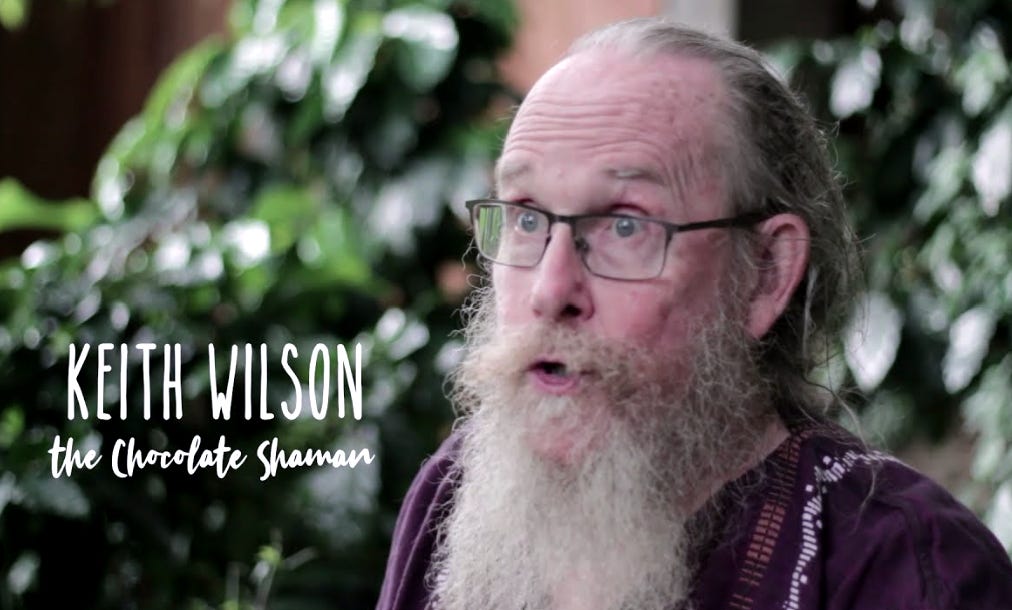
His words: “The local shamans used tobacco and alcohol. They didn’t know anything about cacao. I talked with anthropologists living here in Guatemala for fifty years, they knew of no Central American people using chocolate for ritual or ceremonial purposes.” [^8]
Local spiritual leaders didn’t know about it. Anthropologists who lived there for fifty years had no record of it. But Keith Wilson, freshly arrived from Canada, received direct downloads from the cacao spirit…
He contacted curanderos in the Yucatan and discovered they were fond of cacao but “clueless as to how to contact its spirit.” Wilson then developed meditative techniques from the spirit’s instructions and introduced them to natives and Westerners near Lake Atitlán. Blending practices with Amazonian philosophy, he pitched cacao as a “facilitator of creativity” to artists, corporate leaders and tech bros. [^9]
His website boasts: "We started it here, the chocolate ecstatic dance, chocolate yoga, chocolate breathwork, chocolate keertan and chocolate sound healing. It all began here.” [^10]
Explicitly: he started it. None existed before 2011
You can become certified through Keith’s website to open your own cacao healing business as a licensed “guardian.” The entire thing is multilevel marketing dressed with an indigenous flare.
The Goddess That Never Was
Central to the ceremonial cacao industry is pointing to “Ixkakaw,” allegedly the ancient Maya goddess of chocolate, for spiritual legitimacy. Except she’s not ancient. She’s not a goddess. She barely exists.
Google “Ixkakaw” and you’ll find recently made products with attempted vintage aesthetics and AI-generated images, but no trail of breadcrumbs to any precolumbian or colonial-era image. The syllabic glyph KA-KA-WA references the plant, not a deity. Despite the Maya having multitudes of spirit effigies, stone monuments and images from ancient times to today, we cannot find a single image or name glyph of this proposed paramount goddess.
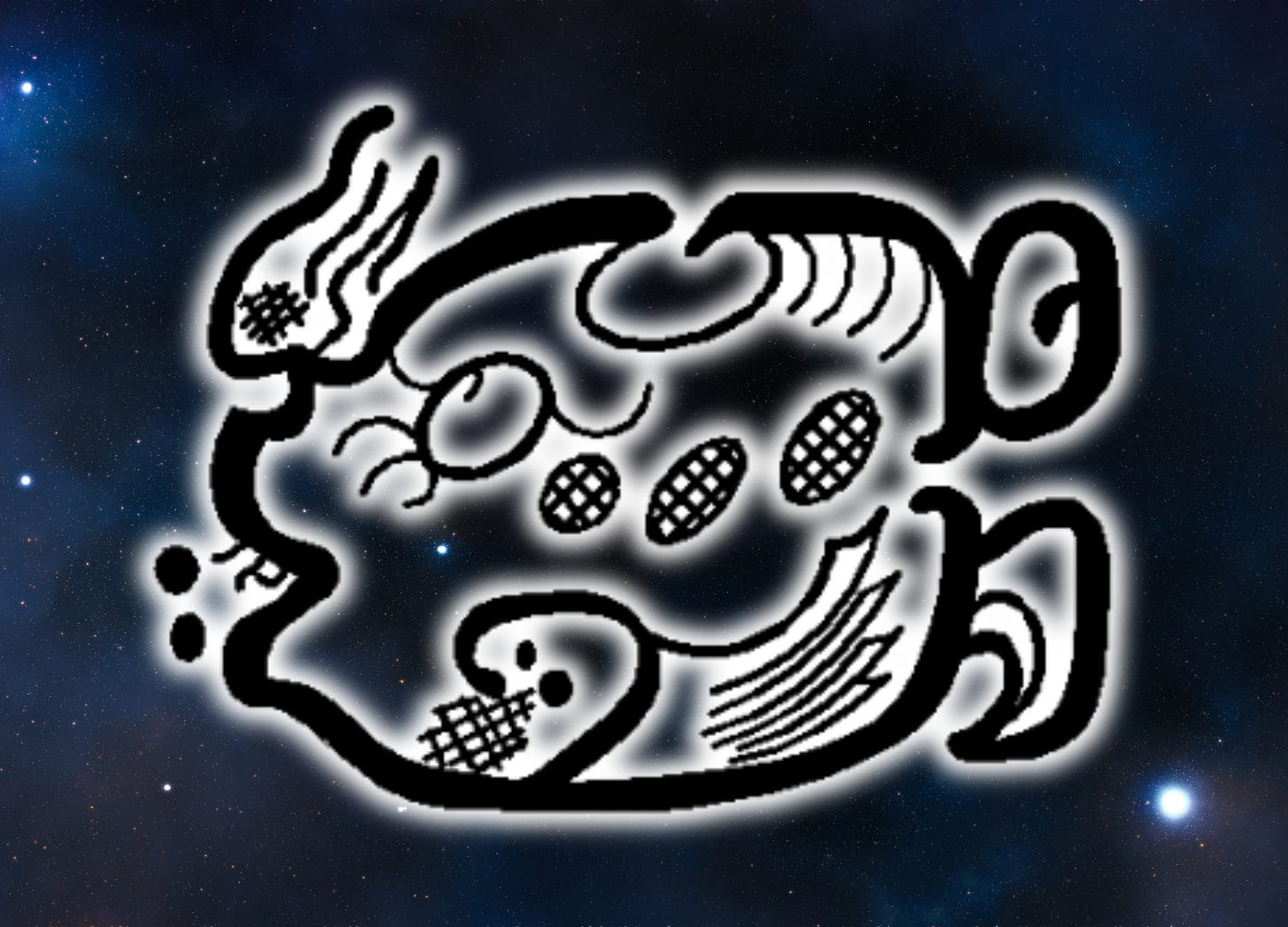
There is exactly one reference to “Ixkakaw” in the entirety of Mayan literature or mythology.
In both Allen Christenson's literal translation and Sam Colop's Spanish translation of the Popol Vuh, one scene describes the mother of the Hero Twins performing a miracle that raises a crop overnight from a barren field. She recites an incantation summoning what Maya groups in Guatemala call "animistic female guardians of the crop." Within this incantation, Ixkakaw is mentioned once. Once. [^12]
By comparison, Hunahpu has 152 references in the Popol Vuh. Ixkik, the divine feminine who summons the animistic guardians (including the cacao spirit), is mentioned over 60 times. If Ixkakaw was venerated as a central personified deity of importance among the Maya, there would be more than one obscure reference. [^13]
An absence of visual, textual and ritualistic evidence all point to one conclusion: while the Maya had unique respect for cacao, it was by no means a deity in the classic sense, nor was it approached as a foundational pillar for spiritual practice.
Cacao healing ceremonies are the quintessential “missing the forest for the trees.” Spotlighting cacao while ignoring the rich depths of Maya cosmovision isn’t just suboptimal. It is cultural appropriation.
How New Age “Shamanism” Undermines Indigenous Practice
New Age cacao ceremonies directly oppose indigenous beliefs by negligently replacing native customs with gentrified distortions:
Ecstatic Dance undermines traditional dances: like la Danza de los Venados (Dance of the Deer), which carry specific cultural and spiritual significance rooted in actual Maya tradition.
Importation of chakras undermines the Maya concept of Koyopa: like the bodily reservoirs of lightning energy that exist within Maya cosmology, replaced by appropriated-Hindu concepts (appropriated because Hindus did not bring chakras to Mesoamerica, white spiritual entrepreneurs did) stripped from their own context.
Sound healing undermines the playing of marimbas during ceremony: actual Maya musical tradition replaced by appropriated-Tibetan singing bowls and other appropriated instruments.
Cacao healing ceremonies undermine the most sacred of Maya plants: Ixim (corn): Corn is the sacred substance from which humanity was created in Maya cosmology. Corn is central, foundational, irreplaceable. To elevate cacao’s divine status to the point of undermining corn could be considered sacrilegious in a way and should be acknowledged as a product of first-world white privilege.
Why Maya People Participate: The Economics of Appropriation
There are Maya people, including Maya elders, who perpetuate this cacao craze. Before judging them, let’s understand the economics.
The level of poverty in developing countries is incomprehensible to the American and European experience. The question of why anyone would “sell out their culture” or something considered sacred can be answered quickly if you genuinely break away from the tourist traps. Easy lives of crime, a day’s wages, addictions, feeding one’s family, feeding oneself are all common reasons.
This is not unlike sales pitches about Santa Muerte in Mexico City markets. “Death comes for us all, so we can all work with her” is very easy to say when your purpose is buying and selling. Bartering and survival are customs unfamiliar to the industrialized world. Eight dollars is a cup of coffee to Westerners; it’s enough to serve a family supper elsewhere. [^14]
These things do not make the situation right. They make it complicated.
The cacao ceremony industry is typically natively employed in making cacao. But its promotional efforts, ceremonial frameworks and profit margins are owned by Anglo-Saxon Americans, Canadians and Europeans. Tell first-world consumerism that you can make a religion out of chocolate and they will take a mile where there is only an inch.
Is There a Legitimate Cacao Ritual?
Is there a place for cacao in modern Maya spiritual practice? Yes. Three competent ways:
First: Hospitality. As depicted in precolumbian times and upheld in Guatemalan households today. Simply a mindful expression of hospitality and gesture of giving attention to others.
Second: Offering. Maya Aj’qi’ab offer cacao in Fire Ceremonies among other offerings. Having a cup of cacao and conversation with its actual patron figure, Ek Chuah, is wildly appropriate and revelatory. This is not unlike how devotees of Maximón interact with him across North and Central America.
Third: The Actual Ritual From the Popol Vuh. Whether from lack of research or lack of authenticity, cacao circles have yet to perform the actual ritual mentioned in the Popol Vuh. It’s a ritual incantation in the proper sense. The irony is that it’s not strictly a cacao ritual. It is a ritual to the holy crops of the Maya. To honor cacao properly, we must honor beans, squash and Ixim (corn) simultaneously.
Ixkik, the mother of the Hero Twins, performed this ritual. It should be maintained to give our ancestors and cosmos proper respect in the face of fashionable ignorance.
Conclusion: What Needs to Change
Cacao should be seen as a helpful tool that comes from Maya roots. It would be silly to ignore the health benefits: from pregnancy support to abundant antioxidants, cacao is a rightful plant ally doing what animistic helpers do.
Even authentic leaders like Apab’yan Tew don’t believe cacao should be discarded because of recent appropriation. But we can do better than the current situation.
The solution needs to be natively employed, natively managed and natively owned. Right now, indigenous people make the cacao. White entrepreneurs run the ceremonies, control the marketing and collect the profits.
This isn’t about gatekeeping. This isn’t about saying non-indigenous people can never drink cacao. This is about stopping the wholesale fabrication of indigenous spirituality for profit. This is about not paying hucksters hundreds of dollars plus for invented traditions while actual Maya practitioners struggle with poverty.
If you want to work with cacao respectfully:
Learn actual Maya history and cosmology. Not the New Age version. The real thing, from indigenous sources. For starters, read the Popol Vuh.
Support Maya-owned businesses and practitioners directly. If you’re paying for a cacao ceremony, make sure the money goes to indigenous communities, not white entrepreneurs.
Stop calling invented practices “ancient.” Chocolate yoga is modern. Own it. Don’t dress it up in stolen indigenous clothing.
Honor cacao in its actual context: hospitality, offering and as one element among many sacred plants and never elevated above corn.
The ceremonial cacao industry beast will continue as long as it is fed with profit. Our job as spiritual seekers—if we are serious about decolonizing spirituality, is to stop feeding said beast. Let’s stop paying for fabricated traditions. Stop elevating white “shamans” over indigenous practitioners and archeologists. And let’s stop pretending that spiritual consumerism is the same as spiritual practice.
Services
Mayan Life Path Astrology Birth Chart Reading: an in-depth soul blueprint analysis that reveals your cosmic destiny through ancient Maya Telluric Astrology, analyzing your daysign, trecena, Venus cycle, Lord of Night, birth year energy and peak manifestation days based on your exact birth moment.
References
[^1]: Archaeological evidence from Colha, Belize, demonstrates Preclassic Maya use of cacao through chemical analysis of theobromine residues in burial vessels, confirming elite association with the beverage.
[^2]: The Maya glyph for cacao reads syllabically as KAK-A-WA, with pronunciation surviving essentially unchanged to present day. Evidence from murals at Calakmul and other sites shows cacao’s role in diplomatic and ceremonial contexts.
[^3]: Ancient Mesoamerican preparation methods emphasized creating foam by pouring from height, with the frothy top scraped off using bone or turtle shell implements.
[^4]: Ek Chuah (God M in archaeological designation) served as patron deity of both merchants and cacao. Ha’al Chuah (God L), depicted as an elderly lord surrounded by cacao imagery, represents this connection in Maya cosmology.
[^5]: Historical trajectory of cacao consumption from elite Mesoamerican beverage through Spanish colonial appropriation to Swiss milk chocolate innovation demonstrates continued pattern of transformation through dominant cultures.
[^6]: Apab’yan Tew, interview, Maya Daykeeper YouTube channel, March 16, 2024.
[^7]: Keith Wilson, “Keith’s Cacao,” www.keithscacao.com, accessed November 28, 2024.
[^12]: Allen J. Christenson, Popol Vuh: The Sacred Book of the Maya (Norman: University of Oklahoma Press, 2007); Sam Colop, Popol Wuj (Guatemala City: F&G Editores, 2008).
[^13]: Comparative frequency analysis of deity names in the Popol Vuh demonstrates Hunahpu’s 152 references and Ixkik’s 60+ references versus Ixkakaw’s single mention as animistic guardian rather than central deity.
[^14]: Economic realities of developing nations create conditions where indigenous peoples may participate in appropriative practices for survival, with $8 USD representing substantial income rather than casual expenditure.
Thank you for sharing the truth of the uses of cacao.