

For sixty years the standard view held that the Maya paid no attention to Mercury. They had no glyph for it, no obvious table, nothing like the Venus pages that make the Dresden Codex famous.
But they did have a detailed account of Mercury in several forms, one of which serendipitously is a winged messenger.


The Planet That Hides
Mercury never strays far from the Sun. You can catch it with the naked eye only in the short windows near its greatest elongations, low in the glare, before dawn or just after sunset. The rest of the time it is simply gone.
Susan Milbrath drew the obvious conclusion: a planet that spends most of its life invisible should leave its traces in underworld imagery. [^2]
And the Dresden scribes were watching. A 2022 analysis of the codex found nineteen recorded dates clustering around Mercury’s maximum elongations and 9 more falling near its conjunctions with the Sun. [^3] They tracked the planet in the only moments it could be seen. The conjunction, which no one can observe, they appear to have calculated as the midpoint between the two visible ends.
The method of the magic was computing Mercury’s back and forth from the underworld to celestial siting.
Two Gods, One Planet-Mesoamerican Duality
In Classic Maya art there is a set of deities who share a strange trait: a T-shaped tooth, probably a shark’s. The company is distinguished: K’inich Ajaw, the radiant lord, is the Sun. God I of the Palenque Triad is Venus at dawn. The Jaguar War God, bearded and wrapped in a twisted fire-cord, is Venus at dusk. Two more sit in that company and Alexander Crim identifies them as Mercury. [^4]
The Pax God takes the dusk, the ink or soot tree. He has no lower jaw. A jaguar’s paw serves as his ear. He appears almost always beside the Jaguar War God, which is exactly how Mercury and Venus behave in the evening sky, the two inner planets crowding the same stretch of horizon after sunset.
On a sculpted throne back he is shown with wings and named ebeet, messenger of Itzamnaaj.
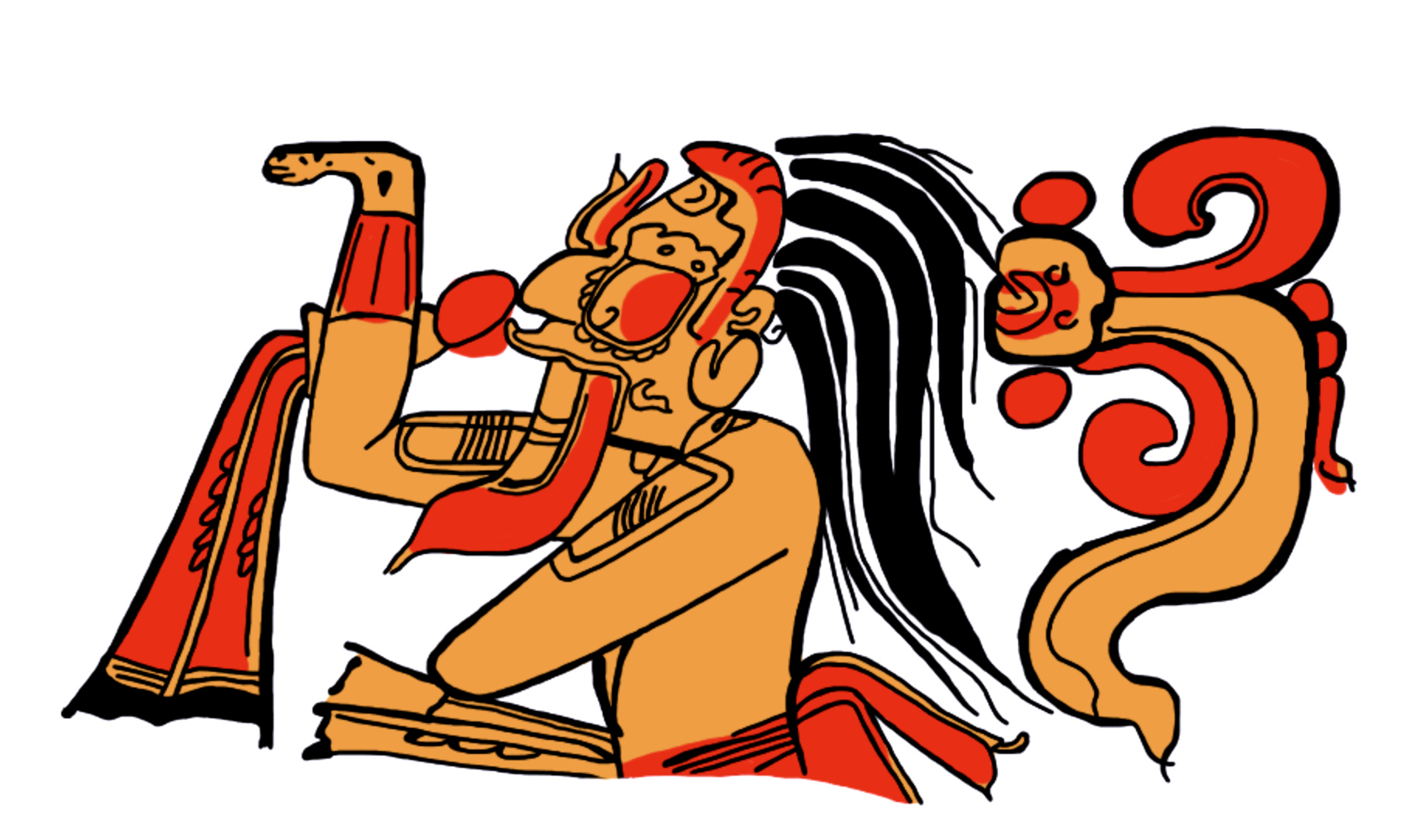
The Classic Maya had a deity identified with Mercury whose titled function was carrying messages between a god and the world and they gave him wings to do it.
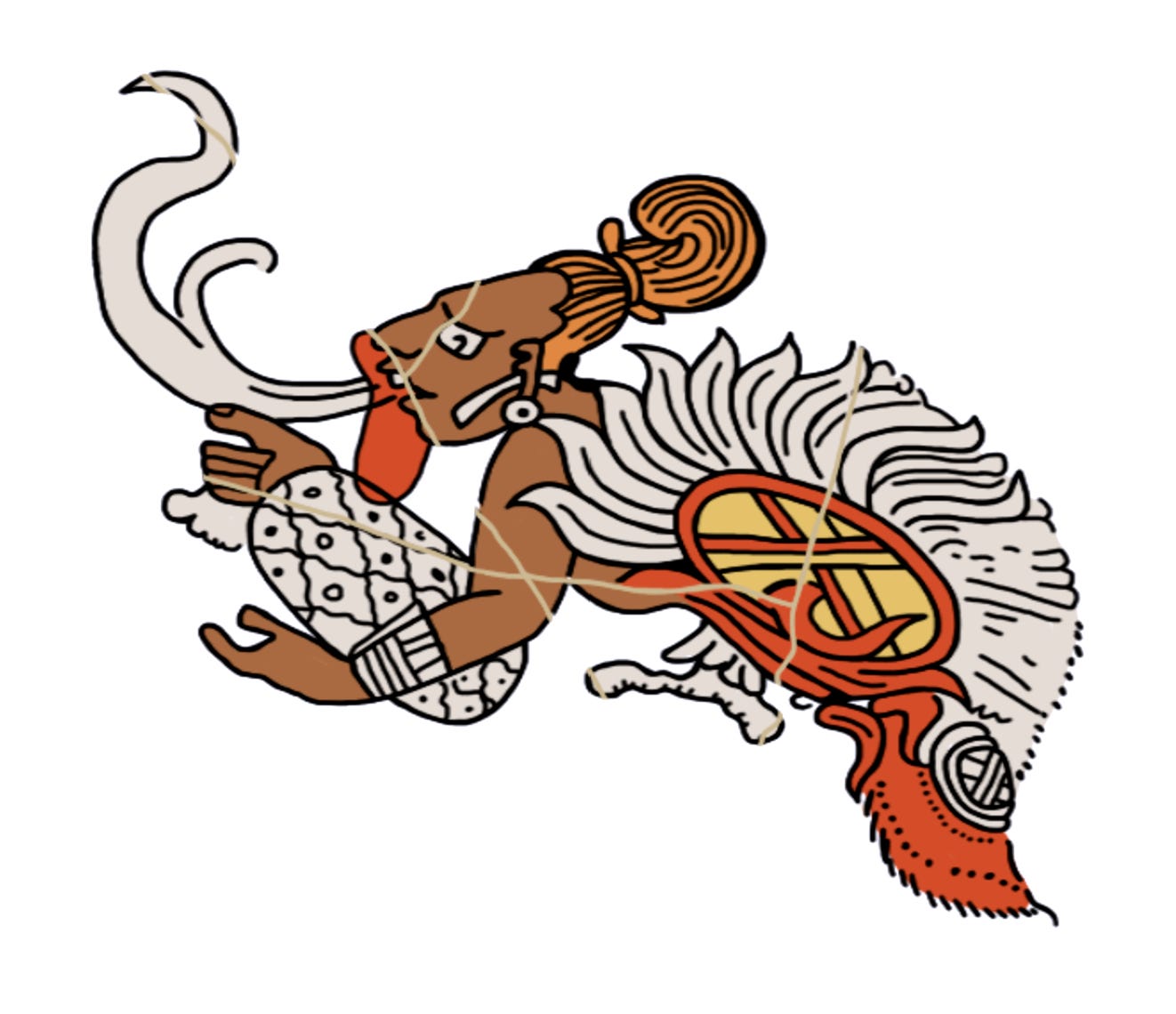
The Bloody-Mouthed God takes the dawn. Blood curls where his lower jaw should be. In some scenes his body is a bird’s.
The planet that hides got a winged courier and a bird.
Alpilcon, the Second Stone of Grace
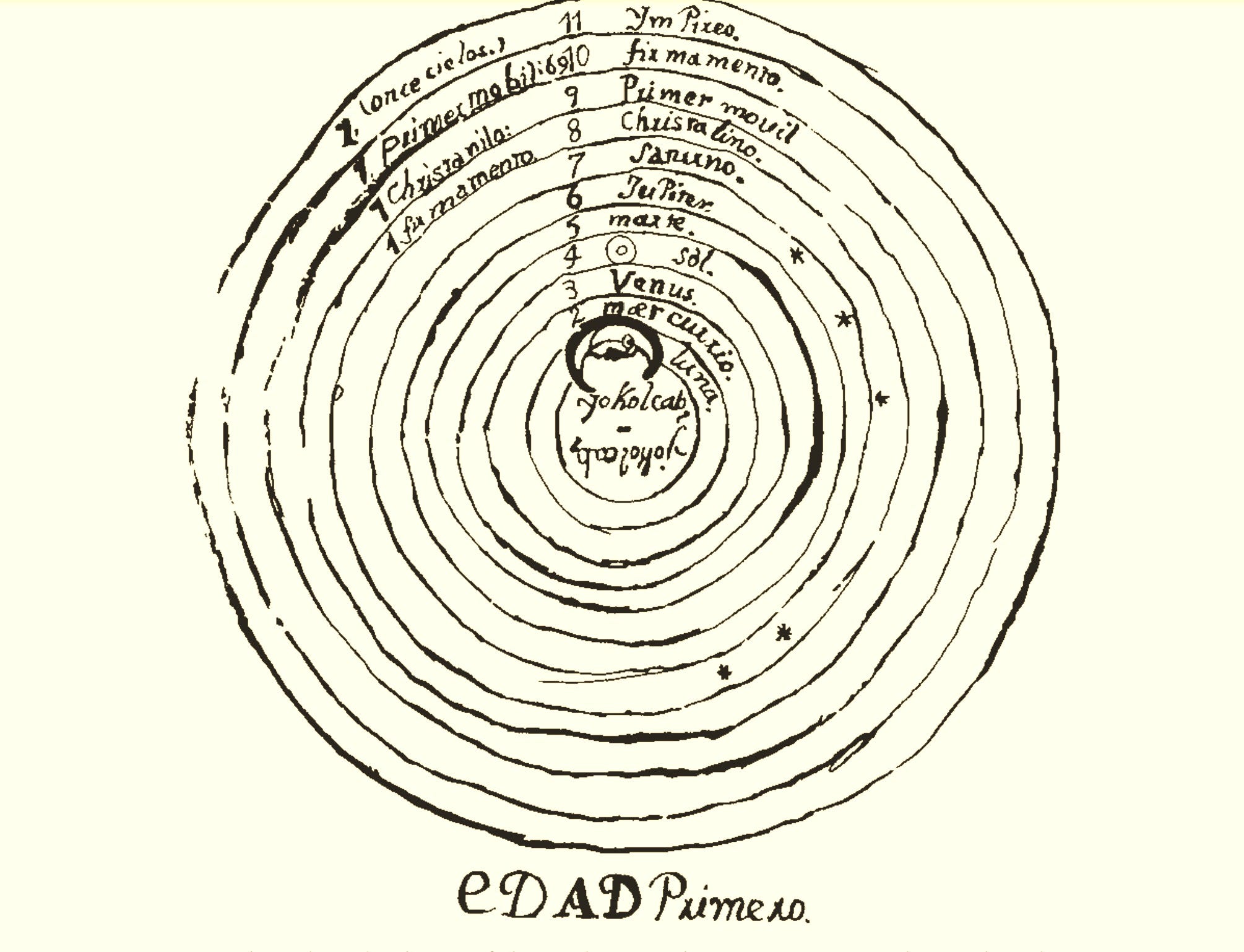
In the Book of Chilam Balam of Chumayel, the world is made through “seven infinite precious stones of grace,” taking the form of the 7 traditional planets. Mercury is the second. It’s Creature is named Alpilcon. [^5]
Three Winals and the Bird Day
Here is what the current retrograde looks like in the count.
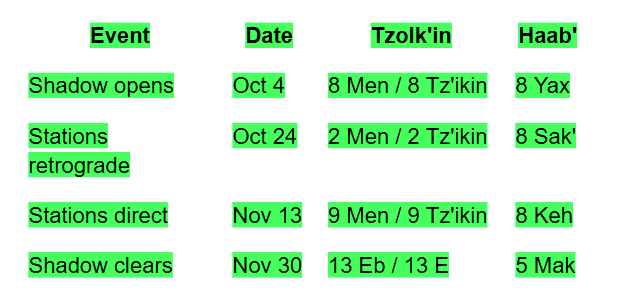
Three boundaries, each exactly twenty days from the last. One winal, then another, then another. And every one of them falls on Men, in K’iche’ Tz’ikin, the day of the bird.
The bird goes out. The bird turns. The bird comes back.
Then the whole passage closes on 13 Eb, the Road, carrying the highest number in the count. The messenger finishes and the road shuts behind him.
Crim’s table of Classic dates includes a Mercury-at-dawn event recorded at Palenque in 712, on 6 Men. The same Daysign, thirteen hundred years ago, with the same planet in the same phase.
Note the Haab’ column too. Eight Yax, eight Sak’, eight Keh. The same station in three consecutive months.
And on November 4, Mercury passes through the heart of the Sun. That day is 13 Kimi, 13 Kame, the death sign at full weight, auspicious during this time of year. The invisible passage the Dresden scribes could only compute, landing on the day of death at its heaviest number.
The Eight-Year Lock
Twenty-five Mercury cycles come to roughly 2,897 days. Five Venus cycles come to about 2,920. Eight of our years come to 2,922.
Within a day or two, all three close together. [^6]
Mercury is not a separate transit from the Venus retrograde in Scorpio that shifts into Libra on October 25. They are gears in the same machine and that machine comes back around every eight years whether anyone is counting or not.
Four Things the Maya Knew About Time
Most of what frustrates people about retrogrades comes from standing in the wrong cosmology. Four principles, before any advice.
Time is carried, not spent. A day is not an empty container you fill with events. It has a bearer, a number and a patron and those three decide what the day is for. You do not have twenty days of Mercury retrograde. You are in Mercury’s custody for twenty days.
Invisibility is not absence. The scribes could not see the conjunction and never pretended they could. They marked the two visible ends and worked inward. What you cannot observe, you bracket. You do not guess at it and you do not fill it with a story.
The messenger is not the message. Ebeet is a role. Something that arrives has been carried and it has been somewhere before it reached you. The Maya gave that function a face, a name, and wings.
The circuit, not the line. Twenty-five Mercury cycles, five Venus cycles, eight years, all closing at once. Nothing in this system runs in a straight line, so nothing in it can be interrupted. It can only come back around.
The five mindset shifts that come out of these four principles will be in Part 2 for Paid Subscribers (Mystery University): standing inside the custody, holding the two ends, reading the courier before the letter, marking the death at the midpoint and asking what returns instead of what went wrong.
Services
Mayan Life Path Astrology Birth Chart Reading: an in-depth soul blueprint analysis that reveals your cosmic destiny through ancient Maya Telluric Astrology, analyzing your daysign, trecena, Venus cycle, Lord of Night, birth year energy and peak manifestation days based on your exact birth moment.
Notes
J. Eric S. Thompson, Maya Hieroglyphic Writing: An Introduction, Civilization of the American Indian Series 56 (Norman: University of Oklahoma Press, 1960), 215.
Susan Milbrath, Star Gods of the Maya: Astronomy in Art, Folklore, and Calendars (Austin: University of Texas Press, 1999), 216.
J. Vondrák, V. Böhm, and B. Böhm, “Did Old Maya Observe Mercury?,” Serbian Astronomical Journal 204 (2022): 65–76. These authors argue from the Böhm correlation of 622,261 days rather than the Goodman-Martínez-Thompson value of 584,283 used throughout this publication and by contemporary daykeepers. Their Mercury identifications depend on that correlation; the GMT remains the standard among historians and the living count.
Alexander Crim, “Morning Stars and Evening Stars: Venus and Mercury in Maya Art and Myth,” presentation, Institute of Maya Studies, 2025.
Ralph L. Roys, trans., The Book of Chilam Balam of Chumayel (Washington, DC: Carnegie Institution, 1933), 107–8.
Crim, “Morning Stars and Evening Stars.”